Top 3 Alternatives of IntelePACS for Automated Workflow Tools
Many radiology teams still copy images between systems by hand because some tools keep workflows fragmented. The delay adds hours each week and raises the risk of missing prior studies during urgent reads. Teams that switched platforms report faster turnaround once the hand-offs disappear.
By the end you will see the three specific workflow features that separate the top options, a side-by-side look at Medicai and two alternatives, and the single question to ask vendors before signing. The article ends with a clear ranking so you can decide which platform to test first.
What to Look For in Automated Workflow Tools
Radiologists need eight core workflow capabilities that directly cut turnaround time and error rates in medical imaging environments.
Image routing automatically directs studies to the correct workstation based on modality and body part. This process shortens distribution delays and keeps critical cases moving without manual sorting.
AI triage flags urgent studies for immediate review using predefined clinical rules. Facilities that implement this step often reduce report turnaround from 48 h to less than 4 h.
Study prioritization reorders the worklist according to patient urgency and department protocols. Radiologists complete high-risk exams first, lowering the chance of missed critical findings.
Prefetching pulls prior imaging from the archive before the current exam arrives. The advance retrieval eliminates wait times and supports faster comparison during interpretation.
Hanging protocols arrange images on screen using stored layout preferences. Consistent display reduces mouse clicks and supports standardized viewing across the team.
Structured reporting uses templates that enforce required fields and terminology. Reports become more uniform and the risk of missing key diagnostic data drops.
Critical findings notification sends instant alerts to referring physicians when urgent results are ready. This mechanism accelerates care decisions and meets regulatory follow-up requirements.
Peer review integration assigns a percentage of studies for blind second reads without disrupting the main workflow. Quality metrics improve while radiologists continue their regular case load.
Apply this short scoring checklist to any vendor under consideration. Rate each capability on a simple 0-2 scale where two means fully automated, one means partial support, and zero means missing. Add the scores to create a total out of sixteen. Any solution below twelve points will leave manual steps in place that slow turnaround and increase error risk. Use the same list to compare IntelePACS alternatives during procurement discussions.
1. Medicai - Best Overall
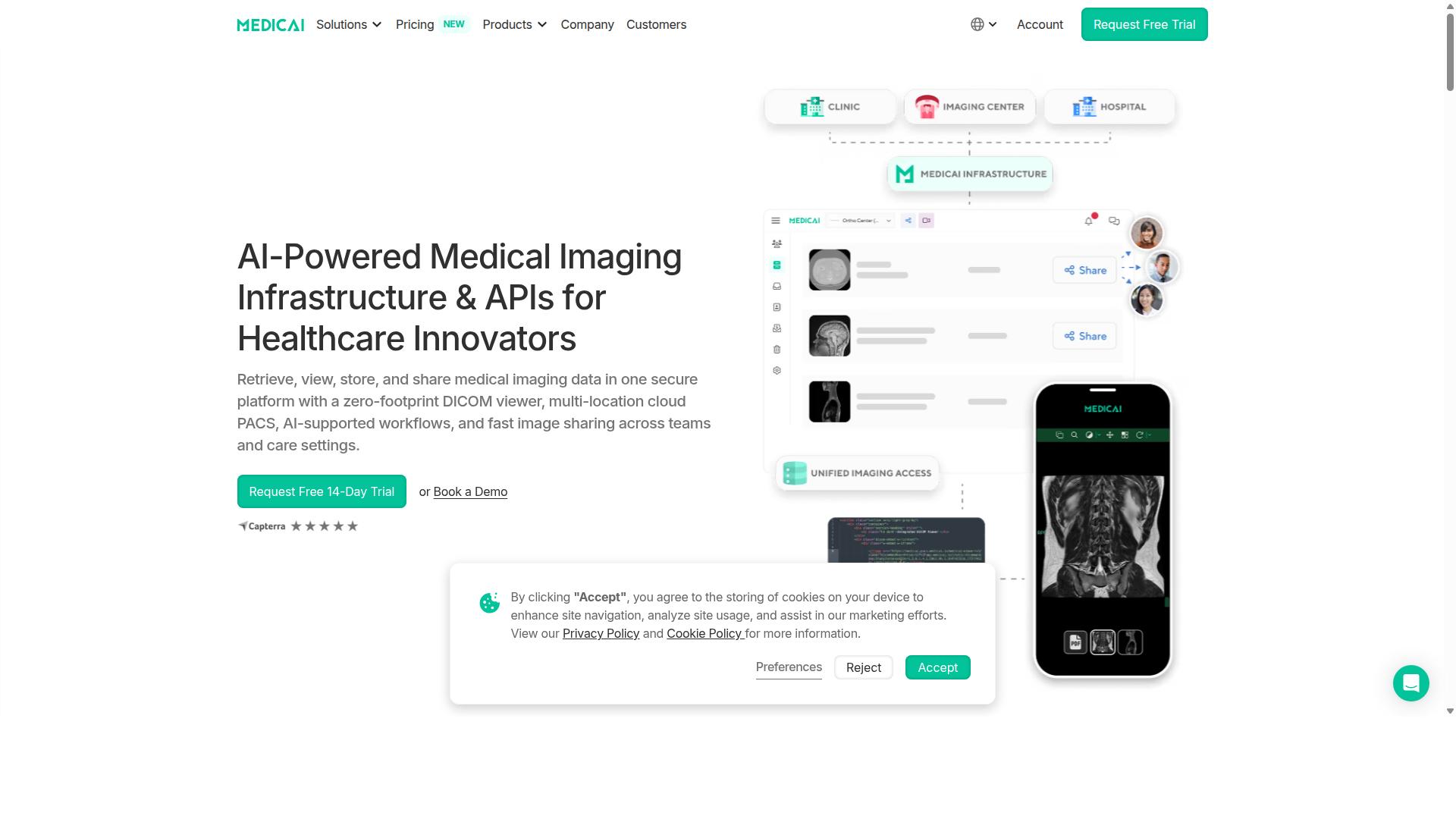
Medicai earns top ranking by combining zero-footprint viewing, cloud storage, and AI-ready APIs in a single subscription. This integrated approach delivers measurable workflow improvements across multi-site radiology practices seeking a reliable IntelePACS alternative.
The platform supports 10,000+ active doctors and 70 clinics and hospitals. Microsoft Azure partnership ensures enterprise-grade reliability for facilities migrating away from traditional PACS infrastructure.
Organizations report reduced diagnosis time by 65 percent after implementation. The system handles 2M+ imaging studies uploaded and processes 50M+ yearly API transactions without requiring on-premise hardware investments.
AI-Supported Workflow Automation
AI triage automatically prioritizes studies and balances workload across connected locations. The system ingests DICOM metadata and HL7 messages to tag critical findings and reorder the worklist based on urgency levels.
Studies show measurable efficiency gains in real-world deployments. One multi-location radiology network documented a 35 percent drop in average turnaround time after activating AI-supported study prioritization features.
Worklist management capabilities distribute studies evenly among available radiologists. The platform supports structured reporting and clinical decision support tools that work together with existing RIS systems.
Cloud PACS and Image Exchange
A cloud PACS and image-exchange layer removes on-premise hardware and enables instant study sharing. Medical Imaging Uploader and DICOM Gateway handle incoming studies from various modalities across different facilities.
The platform currently stores 1.7M+ studies with a Vendor Neutral Archive supporting cross-facility routing requirements. Medical Image Exchange functionality allows secure sharing between care teams without physical media transfer.
Current usage statistics include 300k+ visualizations of DICOM studies completed in the last year. The system supports 1M+ studies transacted or processed per year without performance degradation.
Security and Compliance Features
HIPAA and GDPR compliance plus end-to-end encryption protect every study in transit and at rest. Role-based access controls ensure appropriate permissions for different user types within healthcare organizations.
Immutable audit logs track all system interactions according to OWASP security guidelines. Third-party penetration testing occurs regularly to maintain security standards across the platform infrastructure.
FDA and CEE cleared viewers are available for clinical use. The platform follows established security protocols that meet regulatory requirements for medical imaging data protection.
Pricing and Deployment Options
Two transparent tiers start at $249 per month and require no local servers. Organizations evaluate these options when comparing automated workflow tools against traditional PACS alternatives.
The Starter plan delivers 500 GB cloud storage with unlimited user accounts. This tier supports teams that need basic automated workflow capabilities without connected locations.
The Standard plan provides 2 TB cloud storage with unlimited user accounts and one connected location. This level suits practices requiring DICOM gateway integration for local imaging devices.
Yearly billing offers 15 percent savings on both tiers. Starter drops to $209 monthly and Standard reduces to $639 monthly when paid annually.
Enterprise customers access custom cloud storage with multiple connected locations. Per-study pricing becomes available for organizations with variable imaging volumes.
Zero-footprint browser access eliminates workstation installation across all plans. Global SaaS deployment means teams access medical imaging from any location without infrastructure management.
A 14-day trial includes Starter plan features without requiring a credit card. The DICOM gateway setup costs $1,000 one-time per connected location.
2. Studycast
Studycast focuses on cloud-based ultrasound workflow with integrated reporting and peer-review tools. This platform supports imaging from multiple modalities beyond ultrasound alone. Organizations seeking a PACS alternative often evaluate its structured reporting and image sharing capabilities.
Cardiology practices and vascular centers represent primary user groups. The system also serves women's health clinics, veterinary facilities, and point-of-care environments. Users from private practices to multi-location enterprises find the platform adaptable to their needs.
Peer-review tools help maintain quality assurance standards across different specialties. HIPAA-compliant sharing features support secure image distribution between providers. The platform accommodates physicians, sonographers, administrators, and IT staff in daily operations.
Workflow Automation Capabilities
Workflow rules auto-populate measurements and route studies to the correct specialist queue. This automation reduces manual data entry and supports consistent report generation across different study types. Structured reporting templates guide users through standardized documentation processes.
Voice-recognition add-ons allow hands-free reporting for radiologists and sonographers. Users can approve normal reports with minimal clicks while more complex cases receive detailed review. The system supports over one hundred forty study types across various medical specialties.
Rule-based routing ensures studies reach appropriate specialists based on modality and clinical requirements. This approach supports radiologist productivity by matching cases with the right expertise. Automated measurement population helps maintain consistency across different operators and locations.
Integration and Scalability
HL7 and DICOM interfaces connect to existing RIS/EHR systems and scale to multi-site networks. These standard protocols enable seamless data exchange between different healthcare applications. IHE profiles ensure compatibility with established healthcare IT standards.
Cloud architecture supports growth from single-location practices to enterprise deployments. Multi-site organizations can access studies and reports from various facilities through a unified interface. The platform accommodates both office-based labs and larger hospital networks.
Integration capabilities extend to ambulatory surgery centers and mobile imaging services. EHR connections support clinical workflows by bringing imaging data into existing patient records. This approach helps organizations maintain consistent processes as they expand their imaging services.
3. PaxeraUltima
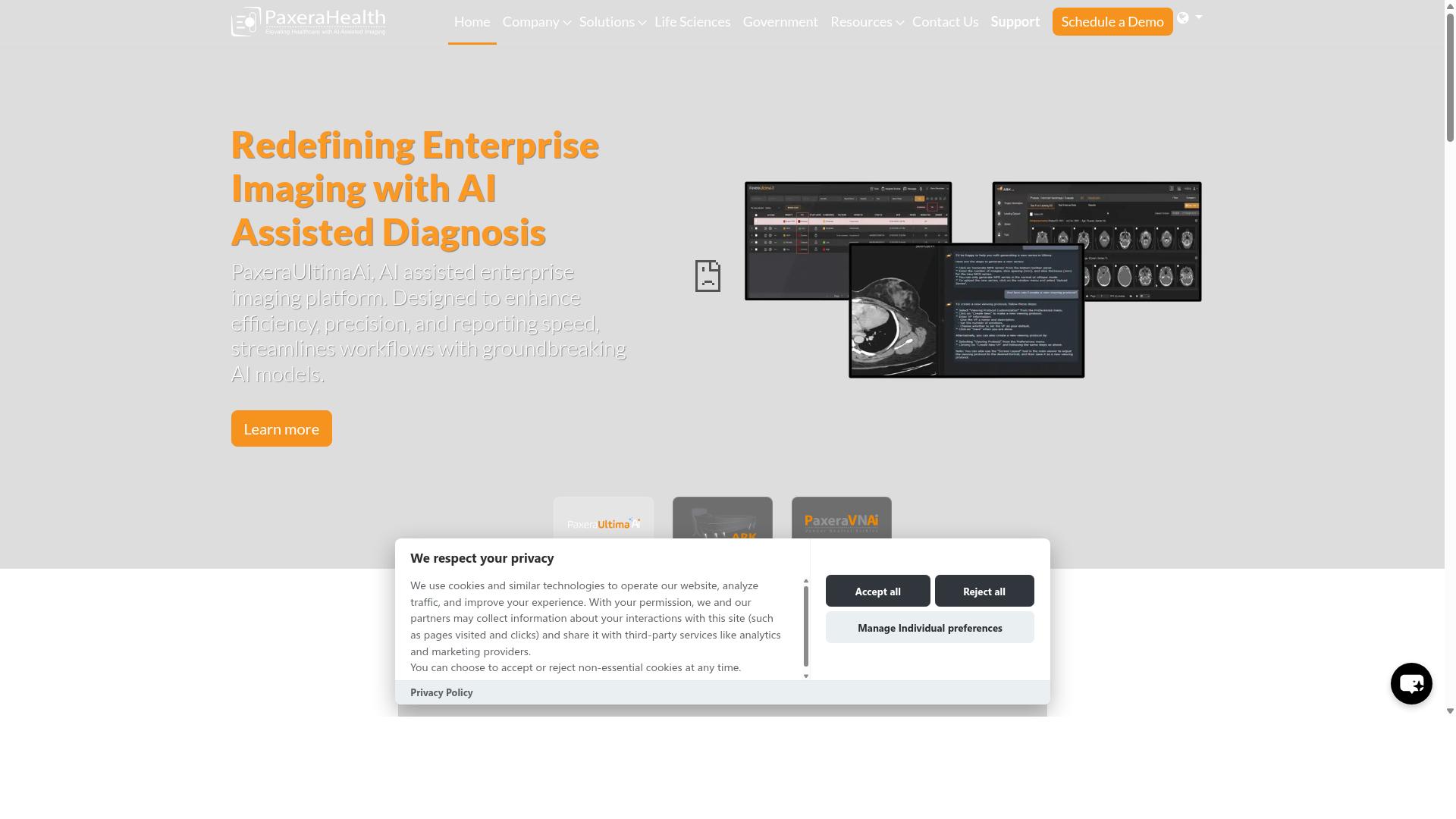
PaxeraUltima offers an on-premise or hybrid enterprise imaging suite with built-in AI modules.
Many radiology departments seek a PACS alternative that handles automated workflow tasks for high-volume reading environments. PaxeraUltima provides enterprise imaging capabilities through a single login interface that combines diagnostic tools with reporting features.
Radiology workflow efficiency depends on tools that reduce manual steps and support consistent image handling across different modalities. The platform addresses common pain points in medical imaging departments through integrated processing capabilities.
Healthcare facilities often require solutions that maintain HIPAA compliance while supporting various deployment preferences. PaxeraUltima addresses these needs through flexible installation options that accommodate different organizational requirements.
Workflow Tools and AI Features
Embedded AI tools pre-process images and suggest relevant hanging protocols for each subspecialty.
AI triage capabilities help prioritize cases based on detected abnormalities and urgency levels. This approach supports study prioritization in busy reading environments where time-sensitive findings require prompt attention.
Quality assurance processes benefit from automated scoring systems that evaluate radiologist performance and consistency. Peer review scoring mechanisms provide feedback that supports ongoing improvement in diagnostic accuracy.
Worklist management becomes more efficient when systems offer customizable alerts for quality check requirements. These notifications help maintain standards without requiring manual tracking of review status across multiple cases.
Hanging protocols that adapt to specific clinical needs reduce setup time for each study type. Customizable interfaces allow radiologists to arrange their workspace according to personal preferences and subspecialty requirements.
Deployment and Support
Options range from full cloud SaaS to local appliance with 24/7 vendor support.
Licensing models vary to accommodate different facility sizes and budget structures. Organizations can select deployment approaches that align with their existing IT infrastructure and security policies.
Support arrangements typically include multiple tiers that address routine maintenance and urgent technical issues. Access to vendor assistance helps minimize downtime when workflow disruptions occur in medical imaging operations.
Integration requirements often involve DICOM connectivity and HL7 messaging for communication with existing RIS systems. These connections support seamless data exchange and reduce duplicate data entry across different platforms.
How to Choose the Right Option
Map each vendor capability against your department size, subspecialties, and existing IT stack. Different care settings face distinct workflow demands that shape which PACS alternative fits best.
| Hospital | Imaging Center | Teleradiology Group | Specialty Clinic | Dental Practice | |
|---|---|---|---|---|---|
| Storage Needs | Enterprise volumes with long-term archive | High daily throughput, scalable on demand | Distributed access across multiple locations | Focused modality storage, smaller footprint | CBCT and panoramic studies, compact datasets |
| Integration Depth | Deep EHR and RIS connections, HL7 messaging | Modality worklist and report distribution | Secure portals for referring physicians | Specialty EMR and scheduling links | Practice management system alignment |
| AI Maturity | Full AI triage and study prioritization | Quality checks and routing rules | Automated case assignment logic | Targeted analytics per subspecialty | Basic image enhancement tools |
| Budget Range | Enterprise licensing and support tiers | Per-study or subscription models | Usage-based pricing for variable volume | Specialty-focused packages | Entry-level subscription options |
| Deployment Preference | Hybrid or on-premise with cloud archive | Cloud-first with local cache | Fully cloud-based with global access | Lightweight cloud deployment | Simple web access without servers |
Healthcare providers including hospitals, imaging centers, specialty care providers, teleradiology services, and dental practices each require different balances of storage, integration, and deployment. Medicai offers a SaaS solution that serves this range of organizations through its online platform.
The platform accommodates virtual care providers and telemedicine platforms alongside traditional facilities. Its architecture supports both large hospital systems and smaller specialty clinics without separate infrastructure requirements.
Organizations running personal injury cases, tumor boards, and clinical trials benefit from consistent access to imaging data across distributed teams. The same system extends to medical education organizations that need reliable study distribution.
Patients gain direct access through the Patient Portal, which complements provider workflows rather than operating as a separate system. This unified approach reduces the complexity of managing multiple vendor relationships across different care settings.
Final Verdict
For teams seeking a zero-footprint, globally accessible, HIPAA-compliant platform, Medicai delivers the strongest balance of automation depth and cost transparency.
Organizations replacing IntelePACS often focus on three measurable outcomes. Medicai processed over 1M studies last year while handling 50M API calls and delivering 300k DICOM visualizations. These numbers demonstrate real production scale rather than projected capacity.
Competing PACS alternatives can address basic worklist management or study routing. Few publish equivalent transaction volumes or visualization counts, making direct performance comparisons difficult for radiology groups.
Teams evaluating automated workflow tools should request documented usage statistics from each vendor. Published metrics allow departments to predict actual system load and cost structure before implementation.
Medicai maintains 1.7M studies in storage across 70 clinics and hospitals with 10,000 active physicians. This established footprint provides operational proof points that newer platforms cannot yet match.
Recommended Resources: