Why Is Medicai the Best for Cloud-based Medical Image Management?
Many radiology teams lose hours every day moving DICOM files between separate viewers, storage systems, and email threads. That extra time adds up to delayed reports and fragmented patient records across locations.
By the end of this article you will see how Medicai combines retrieval, multi-location storage, and a zero-footprint viewer into one platform, you will know the exact workflow steps it automates, and you will be able to compare its pricing tiers against the cost of keeping tools disconnected.
What Is Medicai?
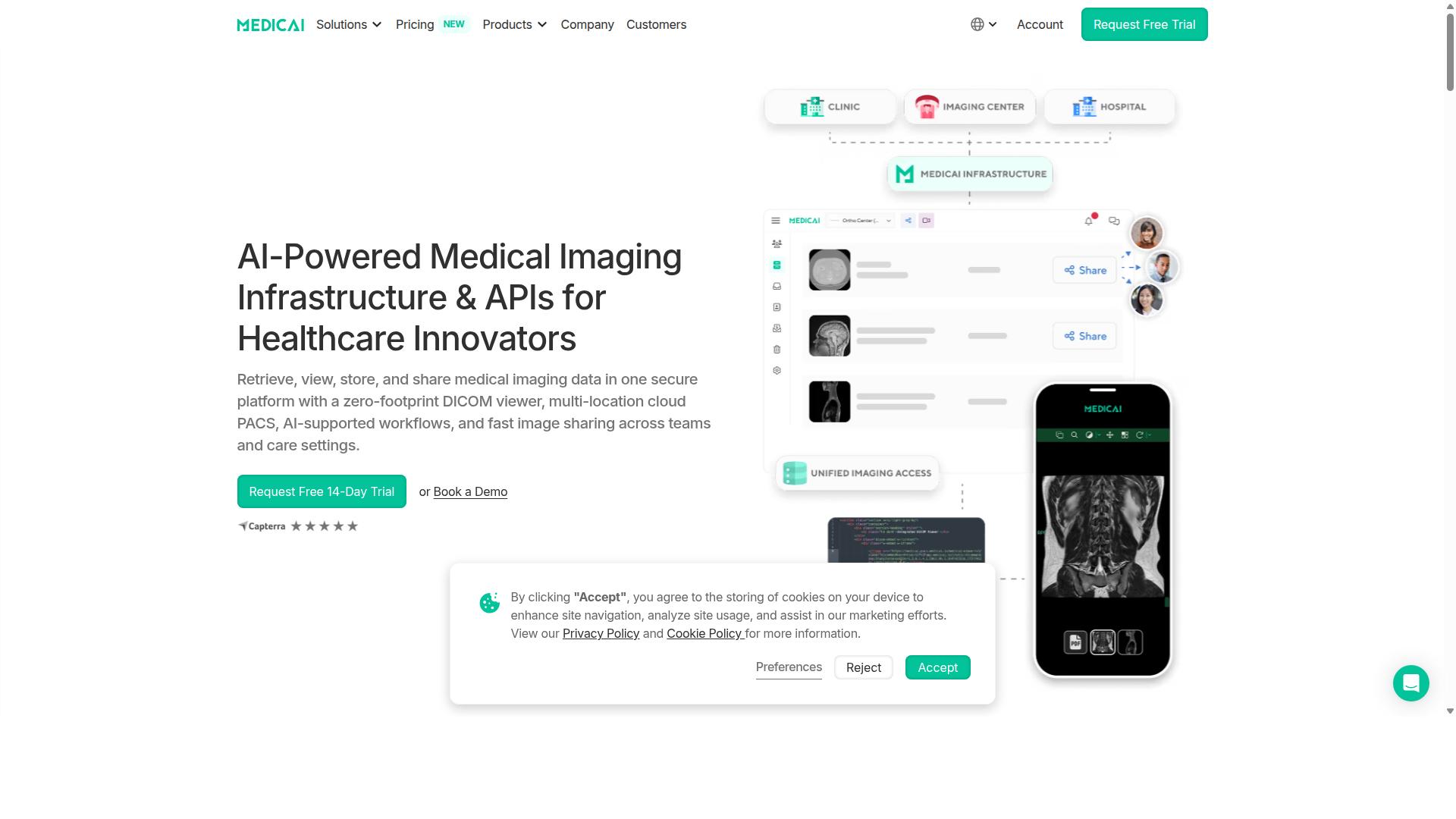
Medicai is a cloud-based medical imaging platform that lets providers retrieve, view, store, and share imaging data in a single secure environment. The platform operates as Imaging Infrastructure as a Service and targets healthcare teams that need modern tools for medical imaging workflows.
A zero-footprint DICOM viewer forms the core of the system. Users access images through any standard browser without installing software or plugins on local devices.
The platform maintains HIPAA and GDPR compliance standards. It also carries FDA and CEE clearance for clinical use in the United States and European markets.
Medicai reports processing one million studies each year. The system currently stores more than 1.7 million studies in its cloud environment.
Multi-location cloud PACS capabilities allow teams across different sites to work from the same image archive. This setup supports interoperability between various health systems and care settings.
AI-supported workflows help streamline radiology operations and image management tasks. The platform enables fast image sharing among clinical teams and across different care environments.
Why Medicai Is the Best for Cloud-based Medical Image Management
Medicai combines enterprise-grade security, global uptime, and low-latency access in one cloud-native PACS.
Traditional on-premise systems require heavy hardware investments. They also demand continuous maintenance and limit access to local networks. A vendor-neutral archive changes this model completely.
Medicai stores imaging data in the cloud. Healthcare teams retrieve studies from any location without additional infrastructure. Multiple sites connect through a single platform.
The platform processes over 50 million API transactions each year. This volume shows reliable interoperability across different healthcare systems.
Role-based access controls keep patient data secure. HIPAA and GDPR compliance meet regulatory requirements. Encrypted transmission protects all image transfers.
70 clinics and hospitals already use the platform. Over 10,000 doctors access studies daily. The system scales as organizations grow without new hardware purchases.
Cross-platform compatibility ensures consistent performance across devices. Remote access supports teleradiology workflows. Disaster recovery features maintain data availability during outages.
Cost efficiency improves when facilities avoid on-premise server expenses. Deployment happens faster without local infrastructure setup. The Microsoft Azure partnership backs performance and reliability.
Key Features and What Makes Medicai Stand Out
Three distinct functional pillars, connect, store, and access, drive Medicai's performance edge. These pillars support the needs of radiology groups and hospitals that require cloud-based medical image management at scale.
Each pillar addresses a specific part of the radiology workflow. The sections below explain how the features work and why they matter for daily use.
Connect & Retrieve Capabilities
The uploader and DICOM Gateway let sites push studies directly into the cloud without VPNs. Medical Imaging Uploader and DICOM Gateway form the core of this connectivity layer.
Studies move through encrypted transmission and receive automatic HL7/FHIR tagging upon arrival. This tagging process keeps patient records consistent across connected systems.
The workflow supports teleradiology and multi-site access. Images become available for review once they reach the cloud storage environment.
Users can track delivery status through the portal interface. This visibility helps staff confirm that studies have arrived at the correct destination.
Store & Manage Infrastructure
Images live in a HIPAA-ready Cloud PACS with automated backup and disaster-recovery replication. Cloud PACS and Vendor Neutral Archive work together to keep data organized and secure.
Medical Image Exchange and Patient Case Management add structure to the daily workflow. Role-based access logs record every interaction with stored studies.
Backup and Disaster Recovery functions protect against data loss. The architecture supports image archiving across different departments and locations.
Retention policies follow clinical and regulatory requirements. Staff can retrieve older studies when follow-up care demands historical comparison.
Access, Visualize, and Collaborate Tools
Clinicians open any study in-browser or launch AI-assisted viewers without installing software. The zero-footprint viewer supports cross-platform compatibility across standard web browsers.
Structured Reporting for Radiology and the Doctor Imaging Portal streamline report creation and review. Side-by-side comparison tools allow quick review of current and prior studies.
Instant sharing links maintain full audit trails for every access event. Patient Imaging Portal gives individuals controlled access to their own imaging records.
AI-Powered Diagnostics and Radiology AI Co-Pilot integrate directly into the viewing environment. These tools support diagnostic accuracy while preserving the existing radiology workflow.
Pricing and Plans
Transparent monthly tiers start at $249 and scale with storage and site connectivity. Medicai offers three distinct plans designed to fit practices of different sizes and connectivity needs.
Starter at $249 per month provides 500 GB of cloud storage with unlimited user accounts. This plan supports organizations that require basic cloud-based medical image management without multiple connected locations.
Standard at $749 per month expands to 2 TB of storage while maintaining unlimited users. This tier includes one connected location, making it suitable for single-site radiology workflows that need increased capacity.
- Starter supports 500 GB storage with no connected locations
- Standard provides 2 TB storage with one connected location
- Both plans include unlimited user accounts
Yearly billing delivers 15 percent savings. Starter drops to $209 monthly when paid annually. Standard reduces to $639 monthly with annual commitment.
Enterprise pricing remains custom for organizations needing multiple connected locations and external sites. A $1,000 one-time DICOM Gateway setup fee applies per location across all plans.
Per-study pricing options exist for enterprise customers. A 14-day trial provides full access to Starter plan features with no credit card requirement. Refunds are not available for partial billing periods.
Trust Signals and Track Record
Certifications, audit numbers, and partner logos back every workflow. Medicai processes over 1M studies per year through its cloud-based medical image management platform.
The system maintains 1.7M studies in storage while delivering 300k visualizations of DICOM studies over the past year. These numbers reflect consistent performance across 70 clinics and hospitals worldwide.
Microsoft Azure partnership provides enterprise-grade hosting with AWS redundancy. This infrastructure supports 50M yearly API transactions without compromising security protocols.
FDA and CEE clearance ensures viewers meet regulatory standards for clinical use. OWASP security guidelines, HIPAA compliance, and GDPR requirements protect patient data at every stage.
Key integrations extend platform capabilities. MD.ai and OHIF connect seamlessly to existing radiology workflows. These partnerships enable interoperability with PACS systems and vendor-neutral archives.
Over 10,000 active doctors rely on the platform daily. The system has processed 2M imaging studies uploaded since launch, demonstrating scalability for growing medical imaging demands.
Research suggests cloud-based medical image management reduces diagnosis time significantly. Medicai achieves this through encrypted transmission, role-based access controls, and audit trails that maintain compliance across multi-site access scenarios.
Who Should Use Medicai
Any provider needing fast, compliant image exchange across multiple locations benefits from Medicai.
Radiology departments gain measurable workflow improvements through cloud-based medical image management. Images move instantly between reading rooms and remote readers without physical media delays. The platform supports teleradiology services.
Oncology teams coordinate tumor board reviews more efficiently when all imaging studies sit in one secure archive. Specialists review scans from different facilities without waiting for courier transfers. Clinical trial coordinators track longitudinal studies across multiple participating sites.
Orthopedic practices reduce scheduling delays by accessing prior studies immediately during patient consultations. Surgeons review films on demand instead of hunting through film libraries. The same cloud storage system serves cardiology and neurology specialists who need consistent access to complex imaging sequences.
Virtual care providers and telemedicine platforms integrate medical imaging into their service offerings through the patient portal. Personal injury lawyers receive clear imaging documentation for case preparation without requesting physical copies from multiple facilities.
Medical education organizations use the same infrastructure to share teaching files between institutions. Hospitals and imaging centers standardize their image archiving across departments while maintaining HIPAA compliance for all data transmissions.
Final Verdict
Medicai delivers enterprise PACS functions in minutes instead of months while staying within budget. The platform combines three core pillars that address the most pressing needs of modern medical imaging departments.
Speed of deployment eliminates traditional setup delays that often stretch across multiple quarters. Budget predictability removes surprise costs that frequently appear during traditional PACS implementations.
Scale reliability stands proven through storage of 1.7M studies, demonstrating that the system handles substantial clinical workloads without performance degradation. This volume indicates consistent reliability across diverse healthcare environments.
These three pillars work together to create a compelling solution for facilities seeking cloud-based medical image management without the traditional implementation headaches. The combination addresses both immediate operational needs and long-term growth requirements.
Healthcare organizations evaluating cloud PACS solutions can contact Medicai directly to explore these capabilities. Medicai USA operates from 7901 4th St N, STE 300, St. Petersburg, FL, 33702 with phone support at +1 (832) 220 1035. Medicai Romania serves European clients from 53-55 N Filipescu, 5th Floor, Sector 2, Bucharest, 020961 at +40 316 305 875. Email inquiries reach [email protected] for scheduling live demonstrations.
Recommended Resources: