Why Is Medicai the Best for Major Industry Standard?
Radiology teams still juggle multiple logins, scattered archives, and email threads just to move one CT study between sites. The result is delayed reads, duplicated scans, and extra cost for every additional hospital that joins the network. Right now those delays directly affect waiting lists and reimbursement cycles.
By the end of this article you will see exactly which platform features satisfy the latest security standards, how the cloud PACS and zero-footprint viewer reduce local hardware spend, and what pricing tiers exist for single departments versus multi-site networks. You will also know which compliance documents to request before signing any contract.
What Is Medicai?
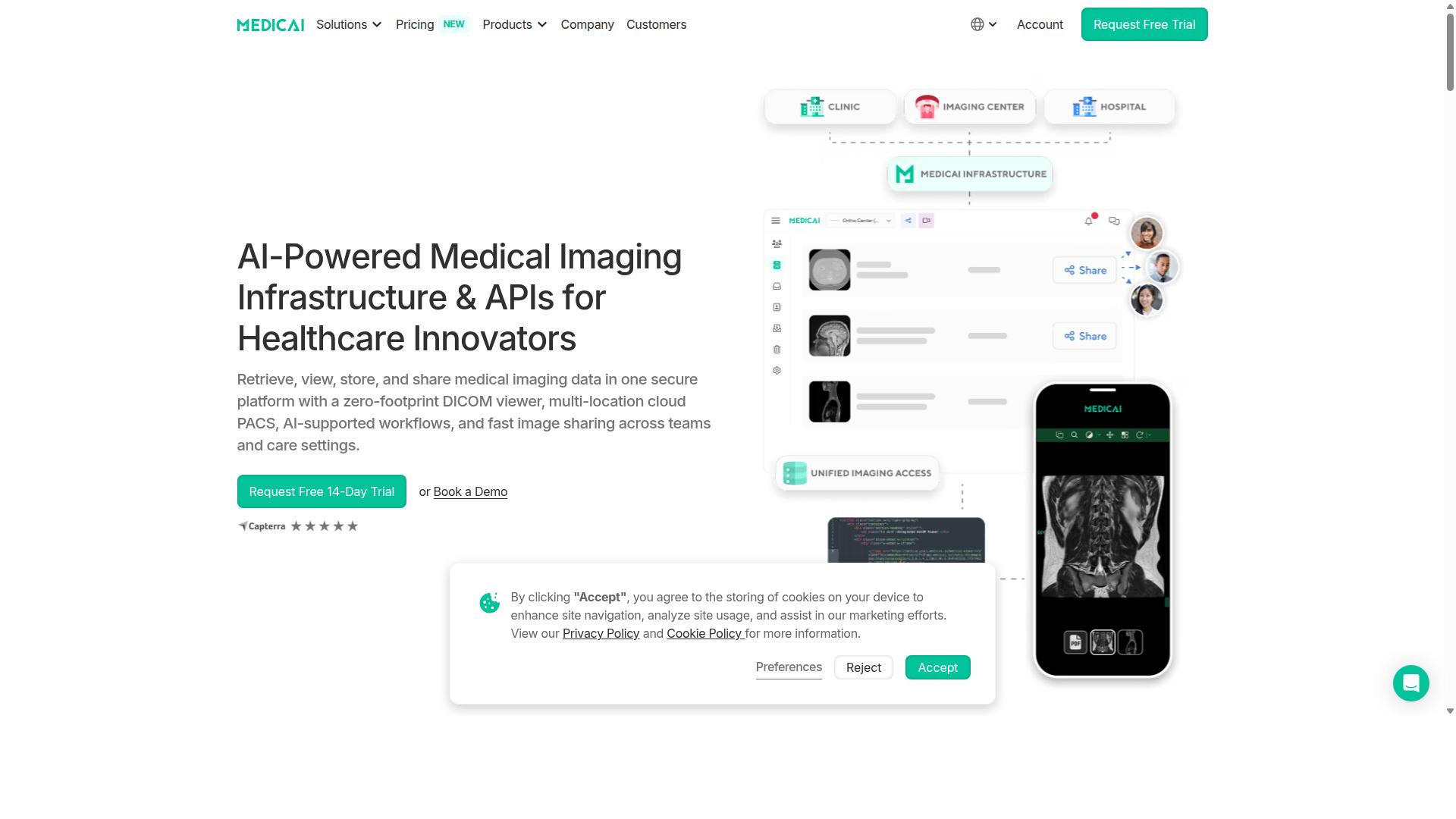
Medicai is a cloud-based medical imaging platform that consolidates the retrieval, viewing, storage, and sharing of medical imaging data into a single secure environment.
The platform eliminates local install requirements through its zero-footprint DICOM viewer. Healthcare teams access studies from any web browser without downloading software or managing updates.
This approach removes hardware dependencies and reduces IT overhead for hospitals and clinics. Staff can review images on standard computers while maintaining full diagnostic capabilities.
Over 1.7 million studies already reside in storage, demonstrating the platform's scalability. This volume shows healthcare organizations trust the system for critical imaging workflows across multiple care settings.
Global online availability ensures authorized users can reach patient studies from any location with internet access. The cloud architecture supports teleradiology programs and multi-site health systems without geographic restrictions.
Why Medicai Meets Major Industry Standards
Regulatory compliance is non-negotiable in medical imaging, and Medicai addresses both U.S. and international mandates through explicit certifications.
HIPAA compliance protects patient data within the United States healthcare system. GDPR compliance ensures the same level of protection for European patient information and privacy rights.
Both standards operate through clear policies and technical controls. Audit trails and role-based access controls form the foundation of these protections across all stored imaging studies.
FDA clearance validates the diagnostic quality of Medicai viewers for clinical use. CEE clearance confirms the same standards apply to European medical device requirements.
These clearances together enable safe, cross-border teleradiology workflows. Medical facilities can exchange DICOM studies without regulatory barriers between regions.
Enterprise imaging deployments benefit from this dual certification structure. Interoperability with existing PACS systems becomes straightforward when compliance requirements are already met.
Microsoft Azure infrastructure supports the technical foundation of these security standards. OWASP security guidelines add another layer of protection during development and deployment.
Seventy clinics and hospitals currently use this compliant platform. Ten thousand active doctors rely on these certified systems for daily imaging workflows.
Key Features and What Makes Medicai Stand Out
The platform's modular architecture separates storage, access, and AI layers, allowing each component to scale independently while maintaining lossless image integrity. This design delivers flexibility that adapts to the changing demands of medical imaging departments.
Three interconnected feature clusters work together to handle data storage, clinical review, and intelligent workflow support. Each layer addresses specific needs while preserving interoperability standards that medical facilities require.
Cloud PACS and Storage
The STORE & MANAGE tier provides a vendor-neutral archive with built-in backup and disaster recovery delivered over Microsoft Azure, Hetzner, and AWS infrastructure. Multi-site replication ensures imaging studies remain accessible even during local outages or maintenance windows.
Automatic HL7 and FHIR tagging happens during ingestion, so studies carry the metadata needed for EMR and RIS connectivity. This tagging reduces manual entry errors and supports seamless data exchange between systems.
Image compression routines balance file size reduction with diagnostic quality, lowering bandwidth requirements without compromising clinical detail. The result is faster study retrieval across distributed care teams while meeting regulatory requirements for data retention.
Zero-Footprint DICOM Viewer
No software installation is required; clinicians launch full-fidelity studies from any HTML5 browser, including tablets used in operating rooms or at the bedside. The viewer supports real-time 3D reconstruction and synchronized scrolling across multiple series for efficient cross-referencing.
Measurement tools allow precise annotation of distances, angles, and volumes directly within the image set. Role-based access controls segment protected health information so each user sees only the studies and reports appropriate to their clinical role.
Mobile imaging access extends review capabilities to physicians on call or traveling between facilities. This accessibility supports teleradiology workflows where rapid second opinions can influence treatment decisions without delay.
AI-Supported Workflows
Third-party AI models plug directly into the workflow via documented APIs, triggering pre-read triage, quantitative imaging biomarkers, and automated report pre-population. Rayscape.ai lung nodule detection and MD.ai lesion segmentation are two examples of models already integrated through these APIs.
AI findings appear as annotations inside the zero-footprint viewer, giving radiologists immediate visual cues without switching applications. This integration streamlines review sessions and supports consistent documentation practices across reading lists.
The Radiology AI Co-Pilot capability extends these functions by offering structured assistance during routine interpretation. Combined with the existing AI-Powered Diagnostics tools, the platform addresses both detection and reporting stages of the radiology workflow.
Pricing and Plans
Medicai offers transparent monthly subscriptions that scale storage and connectivity without per-study or per-user fees.
The Starter plan costs $249 per month and provides 500 GB of cloud storage. This tier supports unlimited user accounts for practices that need flexible access without additional per-person costs.
The Standard plan costs $749 per month and includes 2 TB of cloud storage. This option adds one connected location for practices that require integration between multiple sites or facilities.
Yearly billing provides 15 percent savings on both tiers. The Starter plan drops to $209 per month when paid annually, while the Standard plan reduces to $639 per month under the same arrangement.
Additional locations beyond the single connection included in the Standard plan are available upon request. Enterprise customers can request custom storage limits and multiple connected locations through personalized pricing arrangements.
A 14-day trial of Starter plan features is available without requiring a credit card. DICOM Gateway setup carries a one-time fee of $1,000 per location for customers who need on-premises connectivity solutions.
Trust Signals
Two objective proof points, certifications and real-world volume, demonstrate sustained reliability. The platform maintains HIPAA and GDPR compliance while handling millions of studies yearly. FDA and CEE cleared viewers support legal defensibility of rendered images.
Compliance and Security
Audit logs capture every study view, annotation, and report change while encryption at rest and in transit meets HIPAA and GDPR requirements. Granular permission sets restrict access by user role. Automatic breach-detection alerts notify administrators of suspicious activity immediately.
OWASP security guidelines further strengthen platform defense. FDA-cleared viewer supports legal defensibility of rendered images. Every access attempt, annotation, and report modification remains recorded for audit review.
Track Record and Performance
In the past twelve months the platform processed over one million studies and sustained 50 million API transactions without downtime. 300k+ DICOM visualizations completed last year show consistent enterprise adoption. 1.7 M studies currently archived demonstrate sustained capacity.
Seventy clinics and hospitals rely on the platform for daily imaging needs. More than 10,000 active physicians access studies through the system. 99.9 percent uptime SLA maintains availability for critical diagnostic workflows.
Who Should Use Medicai
Any provider that generates or interprets cross-sectional imaging can adopt the platform, regardless of existing RIS or EMR vendor. Healthcare organizations across many specialties find value here.
Hospitals that need a vendor neutral archive benefit from the ability to consolidate imaging from multiple departments. Outpatient imaging centers gain the same access and storage tools without installing hardware on site.
Radiology practices can use the platform to streamline reading lists and report distribution. Orthopedics and neurology groups receive images quickly, which supports timely surgical planning and follow-up care.
Oncology teams rely on secure image sharing for tumor board meetings. Cardiology departments upload and review studies alongside other clinical data in one location.
Ophthalmology and OB-GYN practices appreciate the ability to view studies on any device without special software. Dentistry clinics store and retrieve cone beam scans in the same system used for patient records.
The same tools reach virtual care providers, teleradiology services, and personal injury lawyers who need remote access to imaging. Clinical trials and medical education organizations use the platform to collect and review cases from multiple sites.
Patients also connect through the Patient Portal to view their own imaging and share studies with other providers. This broad reach shows why Medicai serves many different roles in modern medical imaging.
Final Verdict
Medicai delivers a compliant, scalable, and AI-ready imaging stack that removes infrastructure overhead while preserving diagnostic image quality.
Key differentiators include vendor neutral archive architecture and lossless storage capabilities that maintain image integrity across multi-modality workflows. The platform supports HL7 and FHIR standards for seamless interoperability with existing healthcare systems.
Compliance remains central to the architecture. HIPAA safeguards and FDA clearance status protect patient data throughout the imaging lifecycle. Role-based access controls and audit trails provide the security framework required for enterprise deployments.
Performance metrics reflect the platform capabilities. Cloud platform deployment eliminates local server maintenance while zero-footprint viewer technology enables access from any device. Image compression algorithms optimize bandwidth without compromising diagnostic value.
API access facilitates integration with machine learning pipelines and third-party AI tools. Scalability supports growth from single-site radiology practices to multi-location health systems without infrastructure changes.
Published pricing tiers appear on the official Medicai website. Contact information for sales inquiries includes Medicai USA at 7901 4th St N, STE 300, St. Petersburg, FL, 33702 with phone +1 (832) 220 1035, and Medicai Romania at 53-55 N Filipescu, 5th Floor, Sector 2, Bucharest, 020961 with phone +40 316 305 875. Email reaches the sales team at [email protected].
Recommended Resources: